

Is It Safe To Shoot 45 Colt Leverrovaltion Ammo Out Of A 1873 Colt Youtube
| .45 Colt | ||||||||||||||||||||||||
|---|---|---|---|---|---|---|---|---|---|---|---|---|---|---|---|---|---|---|---|---|---|---|---|---|
 | ||||||||||||||||||||||||
| Type | Revolver | |||||||||||||||||||||||
| Place of origin | United States | |||||||||||||||||||||||
| Service history | ||||||||||||||||||||||||
| In service | 1873–1892 | |||||||||||||||||||||||
| Used by | Us | |||||||||||||||||||||||
| Production history | ||||||||||||||||||||||||
| Designer | U.S. Regular army | |||||||||||||||||||||||
| Designed | 1872 | |||||||||||||||||||||||
| Produced | 1873–present | |||||||||||||||||||||||
| Variants | .45 Colt +P | |||||||||||||||||||||||
| Specifications | ||||||||||||||||||||||||
| Case type | Rimmed, straight | |||||||||||||||||||||||
| Bullet diameter | .452 in (11.5 mm) | |||||||||||||||||||||||
| Neck bore | .480 in (12.2 mm) | |||||||||||||||||||||||
| Base bore | .480 in (12.two mm) | |||||||||||||||||||||||
| Rim diameter | .512 in (xiii.0 mm) | |||||||||||||||||||||||
| Rim thickness | .060 in (one.5 mm) | |||||||||||||||||||||||
| Example length | i.285 in (32.six mm) | |||||||||||||||||||||||
| Overall length | 1.600 in (xl.vi mm) | |||||||||||||||||||||||
| Instance chapters | 41.60 gr HiiO (2.696 cm3) | |||||||||||||||||||||||
| Rifling twist | 1 in sixteen in (410 mm) | |||||||||||||||||||||||
| Primer type | Large Pistol | |||||||||||||||||||||||
| Maximum pressure (CIP) | fifteen,900 psi (110 MPa) | |||||||||||||||||||||||
| Maximum pressure (SAAMI) | 14,000 psi (97 MPa) | |||||||||||||||||||||||
| Ballistic operation | ||||||||||||||||||||||||
| ||||||||||||||||||||||||
The .45 Colt (xi.43×33mmR), is a rimmed, direct-walled, handgun cartridge dating to 1872. Information technology was originally a black-powder revolver circular adult for the Colt Single Action Army revolver. This cartridge was adopted by the U.S. Ground forces in 1873 and served as an official US military handgun cartridge for 14 years.
History [edit]
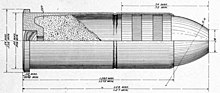
Diagram of .45 Filly U.Due south. Army "ball cartridge" for Army M1909 revolver, with dimensions in inches.
The .45 Colt was a articulation development between Colt'southward Patent Firearms Manufacturing Visitor, of Hartford, Connecticut, and the Union Metal Cartridge Company of Bridgeport, Conn. Colt began work on the revolver in 1871, and submitted a sample to the U.S. Army in late 1872. The revolver was accepted for purchase in 1873.[1]
The cartridge is an inside lubricated type. The rebated heel type bullet design of its predecessor, the .44 Filly (.452–.454" diameter bullet), was eliminated, since it was an outside lubricated type, which would selection up clay and grit during handling. The .45 Filly replaced the .50 caliber Model 1871 Remington single shot pistol and the diverse cap-and-brawl revolvers converted to take metallic cartridges in use at the fourth dimension. While the Colt remained popular, the Smith & Wesson M1875 Army Schofield Revolver was approved as an alternate, which created a logistical trouble for the Army. The S&W revolver used the .45 S&W Schofield, a shorter cartridge, which would also work in the Filly, however the Army's S&W Schofield revolvers could not bedchamber the longer .45 Colt,[2] and so in 1874 Frankford Arsenal, then nearly sectional supplier of small artillery ammunition to the U.Due south. Army, dropped product of the .45 Colt cartridge in favor of the .45 S&W round. This resolved the Army'due south ammunition logistics problems, but there were yet enough of the longer Colt-length cartridges in circulation once production ceased. The Benet primed .45 Revolver cartridges were subsequently replaced past the 'Model of 1882 Ball Cartridge for Cal. .45 Revolver' which used an external Boxer primer and could exist reloaded at the unit level.[iii] The .45 caliber M1882 cartridge would be officially replaced by the .38 Long Filly in 1892 merely would remain in product until 1896. In 1901-1902 it would one time again be loaded by Frankford Armory for use in the Philippines.
In 1909, the .45 M1909 circular was issued forth with the .45 Colt New Service revolver. This round was never loaded commercially, and is virtually identical to the original .45 Filly round, except having a larger diameter rim (.540 in (xiii.7mm)). The rim is big plenty that information technology cannot exist loaded in adjacent chambers in the rod-ejector Filly model.[4]
The .45 Colt remains popular with renewed interest in Cowboy Activeness Shooting. Additionally, the round has seen resurgence equally a cartridge in handgun hunting and Metallic Silhouette Shooting competitions starting time in the 1950s with the introduction of stronger, heavier framed handguns. The cartridge's popularity has as well increased with the increased marketing of handguns that can too fire the .410 bore shotgun shell, such as the Taurus Judge and the Southward&W Governor, though get-go seen decades before in the MIL Thunder 5. The modern .45 Colt bullet has changed likewise, and it is now .451 inches in diameter for jacketed bullets, and .452 for lead bullets. The .45 Colt became the basis for other rounds, such as the .454 Casull.[5]
Cartridge loads [edit]
The .45 Colt originally was a black-pulverization cartridge, but modern loadings use smokeless pulverisation. The original black-powder loads called for 40 grains (2.6 1000) of black pulverisation behind an Ogival & apartment nosed 255-grain (sixteen.5 1000) pb bullet. These loads developed muzzle velocities of 1,050 ft/south (320 m/south). Still, this load generated too much recoil for the average soldier and was, afterwards a few years, reduced to but 28 grains of black powder yielding 855 FPS in Ground forces tests. Then the introduction of the S&West Schofield revolver with its shorter cylinder and quick loading "Tiptop-Break" frame caused a problem for the Supply Corps in that they at present had to supply two different types of .45 Caliber pistol ammunition. Further troubles were caused by the facts that the Schofield cartridge rim was likewise wide to load into next chambers in the filly cylinder, turning the Colt into a three shooter, if the incorrect ammunition was sent to that particular out post. So, the Ground forces came upward with a short case narrow rim cartridge that only held 26 grains of black pulverisation that could be used in both revolvers. That load gave most 760 Anxiety per Second with a 250-grain bullet out of the Schofield revolver with its shorter Barrel. [6] Because of the ability of the xl Grains of Black Pulverization and its excellent accuracy, the .45 Colt was Known every bit a sure human being stopper and equus caballus killer. It became the nigh-used cartridge at the fourth dimension of its introduction, succeeding the .44-twoscore Winchester.
The .45 Colt at that time did not enjoy the .44-40's advantage of a Winchester rifle chambered for information technology being available, thus assuasive use of the same cartridge in both a pistol and a burglarize.[7] According to rumor at the time, this was attributable to early .45 Colt cartridges having a very narrow rim and causing ejection bug from a rifle bedroom. Today, modern Winchesters, Marlins, and other replicas have remedied this omission well-nigh l years after the fact, and the .45 Colt is now available in modern lever-action rifles.
While this aforementioned rumor has been one of numerous arguments used to explain the lack of a rifle chambered in .45 Colt, it may have only been a case of Colt refusing to authorize the apply of their patented .45 Filly cartridge in other manufacturers' arms. Only after the expiration of Colt's original patents for the .45 Colt did it go bachelor in a rifle.[seven] This, however, does not explicate the absence of a .45 Colt chambering (or indeed any of Colt's own cartridges) in the Colt-Burgess lever-action or Filly Lightning slide-action rifles. Thus lending more credence to the rumored basic problem with Colt'south revolver cartridges when used in rifles. (The modern .45 Filly cartridge rim is withal narrow, simply feature an extractor groove cutting into the base of the instance, a feature common to near mod cartridges but not at all mutual in the late 19th century.)
The U.South. Ground forces'southward .45 Colt round used in its M1909 revolver, which had a barrel of 5.5 inches (140 mm), fired a 250-grain (16 g) bullet at a cage velocity of 738 ft/due south (225 grand/s), giving a muzzle energy of 297 ft⋅lbf (403 J).[8] Today's standard mill loads develop around 400 ft⋅lbf (540 J) of muzzle energy at about 860 ft/s (260 m/s), making information technology roughly equivalent to mod .45 ACP loads. At that place are Cowboy Action Shooting loads which develop cage velocities of effectually 750 ft/due south (230 thou/s).
Cartridges of the Globe states that .45 Colt should never be loaded to more than 800 ft/south (240 m/due south).[nine]
High pressure armament [edit]
Some handloads and factory manufactured cartridges put this round in the same course as the .44 Magnum, using specially made revolvers.[9] [10] These loads cannot be used in whatever original Colt Single Action Army or replica thereof, such as those produced past Uberti, Beretta, the Taurus Gaucho, or the Ruger New Vaquero, as these guns are built on the smaller frame with thinner cylinder walls. These loads should be used just in mod large-frame revolvers such as the Ruger Blackhawk, Ruger Redhawk, and the original big frame Ruger Vaquero (sometimes referred to equally the "Old Model" to differentiate it from the minor frame "New Vaquero.")
Thompson Center Contender "Magnum" .45 Colt loadings tin also be safely fired from any gun chambered in either the .454 Casull or .460 S&W Magnum cartridges, though proper feeding may exist an issue in repeating rifles chambered for either the .454 or .460 equally the OAL is significantly shorter. Mod rifles with stiff actions (such as the Winchester Model 1894, Marlin Model 1894, and new clones of the Winchester Model 1892) chambered for the cartridge tin safely handle the heavier loadings.
Handloading [edit]
Colt .45 revolvers fabricated until early WWII had barrels with .454" groove diameters. After this diameters of .451–.452" were produced. Using .454" bore bullets in the smaller barrels will piece of work but volition generate higher pressures. Cases used with .454" bullets may have to be full length resized to piece of work in newer guns.[11] Speer handloading guidance states that the loads they prove should be used only in handguns made specifically for modernistic smokeless powder. The loads mentioned in No. ten reloading transmission state that they exercise not exceed fifteen,000 psi. This is the equivalent of +P loading as normal pressure for the .45 Filly is xiv,000 psi.[11]
In a section specifically titled "45 Filly for Ruger or Contender only" Speer makes reference to velocities upward to 1300 feet per 2d with 200 grain bullets. They likewise state that pressures do not exceed 25,000 psi (CUP). This is well beyond a pressure level that tin can destroy even modern guns chambered in .45 Filly with the exception of the large frame Ruger Blackhawk, Ruger Redhawk, Freedom Arms Models 83 and 97, and the Dan Wesson.[11]
Uses [edit]
Filly began work on their 1873 Single Activeness Army Model in 1871. Sample cartridges submitted for Army tests were fabricated by UMC, using the Benet cup primers; commercial armament used the Berdan-type primer, followed by the more than common Boxer priming. Original UMC loads used a 40-grain (2.6 1000) powder accuse and 255-grain (16.v g) bullet. This was reduced to 35-grain (2.3 g) of powder, and later, by the Ground forces, to 28-grain (one.8 g).
The .45 Colt cartridge remains in utilise 149 years later its introduction. Information technology is used equally a hunting load on animals the size of deer and black deport. Heavier handloads volition take the same range of big game animals every bit the .44 Magnum. Several two-barrel derringers are sold that are chambered in .45 Colt, and some of these derringers can bedchamber a .410 bore shotgun beat out without whatsoever modifications being required.[12] Revolvers chambered in .410 shotgun, such as the Taurus Judge and the Smith & Wesson Governor, are usually chambered for the .45 Filly equally well. A popular use for the .45 Colt today is in Cowboy Activity Shooting, where the circular is often fired from either original or replicas of the 1873 Colt Unmarried-Action Army.[thirteen]
Winchester, Marlin Firearms, Henry Repeating Arms, Chiappa Firearms, Rossi, Uberti, Cimarron Firearms and other manufacturers produce lever-action rifles chambered in .45 Colt. Colt has resumed product of the Single-Action Army, and many SAA replicas and near-replicas too as mod-design single-actions by Ruger are chambered for this cartridge.
Influence on other cartridges [edit]
The .45 Colt became the basis for the much more powerful .454 Casull cartridge, with the .454 Casull having a slightly longer case utilizing a small rifle primer in place of the large pistol primer. Any .454 Casull revolver will bedroom and fire .45 Colt and .45 Schofield, but not the inverse due to the Casull's longer case. The .460 S&W Magnum is a longer version of the .454 Casull and the .45 Filly. Likewise, .460 Magnum revolvers can chamber and fire the 3 lesser cartridges, merely once again, not the contrary.[14]
Gallery [edit]
-
-
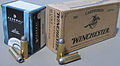
All-lead hollow point and flat nose .45 Colt cartridges
-

.45 Colt cartridges
See also [edit]
- xi mm caliber
- List of handgun cartridges
- Table of handgun and burglarize cartridges
References [edit]
- ^ Taffin, John (2005). Single Activeness Sixguns. Krause Publications. pp. 39–41. ISBN978-0-87349-953-viii.
- ^ Barnes, Frank C. (1997) [1965]. McPherson, M. 50. (ed.). Cartridges of the World (8th ed.). DBI Books. pp. 270, 275. ISBN0-87349-178-5.
- ^ Hackley; et al. (1998). History of Modern U.South. War machine Small Artillery Ammunition. Vol. ane. ISBN1577470338.
- ^ The states. Regular army. Ordnance Dept (1917). Description of the Colt's double-action revolver, caliber .45, model of 1909 : with rules for management, memoranda of trajectory, and description of ammunition, September x, 1909. University of California Libraries. Washington [D.C.] : Yard.P.O. p. 22.
- ^ Taffin, John (August 1, 2010). "A half-century with sixguns: the really big bores". Guns Magazine. FMG. viii (41). ISSN 1044-6257. Retrieved July 25, 2015.
- ^ Taffin, John (July 2001). "The Custom Loading .45 Colt". Guns. Archived from the original on August 26, 2007. Retrieved Feb fourteen, 2011.
- ^ a b Venturino, Mike (1998). "Slingin' Lead". Pop Mechanics. Jay McGill. 175 (4): 76–79.
- ^ U.S. Army Ordnance Section (1917). Description of the Colt's Double-Activity Revolver, Caliber .45, Model of 1909, with Rules for Direction, Memoranda of Trajectory, and Clarification of Ammunition. Washington: U.South. Government Press Office. Page 11 and plate 5.
- ^ a b Cartridges of the World (14th ed.). Iola, WI: Krause Publishing. 2014. ISBN978-ane-4402-4265-6.
- ^ Taffin, John (2010). "Big and heavy". American Handgunner.
- ^ a b c Reloading Manual No. 10. Lewiston, ID: Speer - Omark Industries. 1979.
- ^ Ahern, Jerry (2010). Gun Digest Heir-apparent's Guide to Concealed-Deport Handguns. F&West Media. pp. 207–208. ISBN978-1-4402-1383-0.
- ^ Taffin, John (1997). Big Bore Sixguns. Krause Publications. pp. 33–37. ISBN978-0-87341-502-six.
- ^ Barnes, Frank C.; Skinner, Stan (October 20, 2009). Cartridges of the World twelfth Edition: A Complete and Illustrated Reference for Over 1500 Cartridges. Krause Publications. p. 568. ISBN978-0-89689-936-0.
External links [edit]
- Article on the .45 Colt and the handloading therof
- John Linebaugh discusses loading the .45 Colt Archived 2009-02-06 at the Wayback Motorcar
- Ballistics By The Inch .45 Colt results.
Source: https://en.wikipedia.org/wiki/.45_Colt
Posted by: ottthelver.blogspot.com
0 Response to "Is It Safe To Shoot 45 Colt Leverrovaltion Ammo Out Of A 1873 Colt Youtube"
Post a Comment